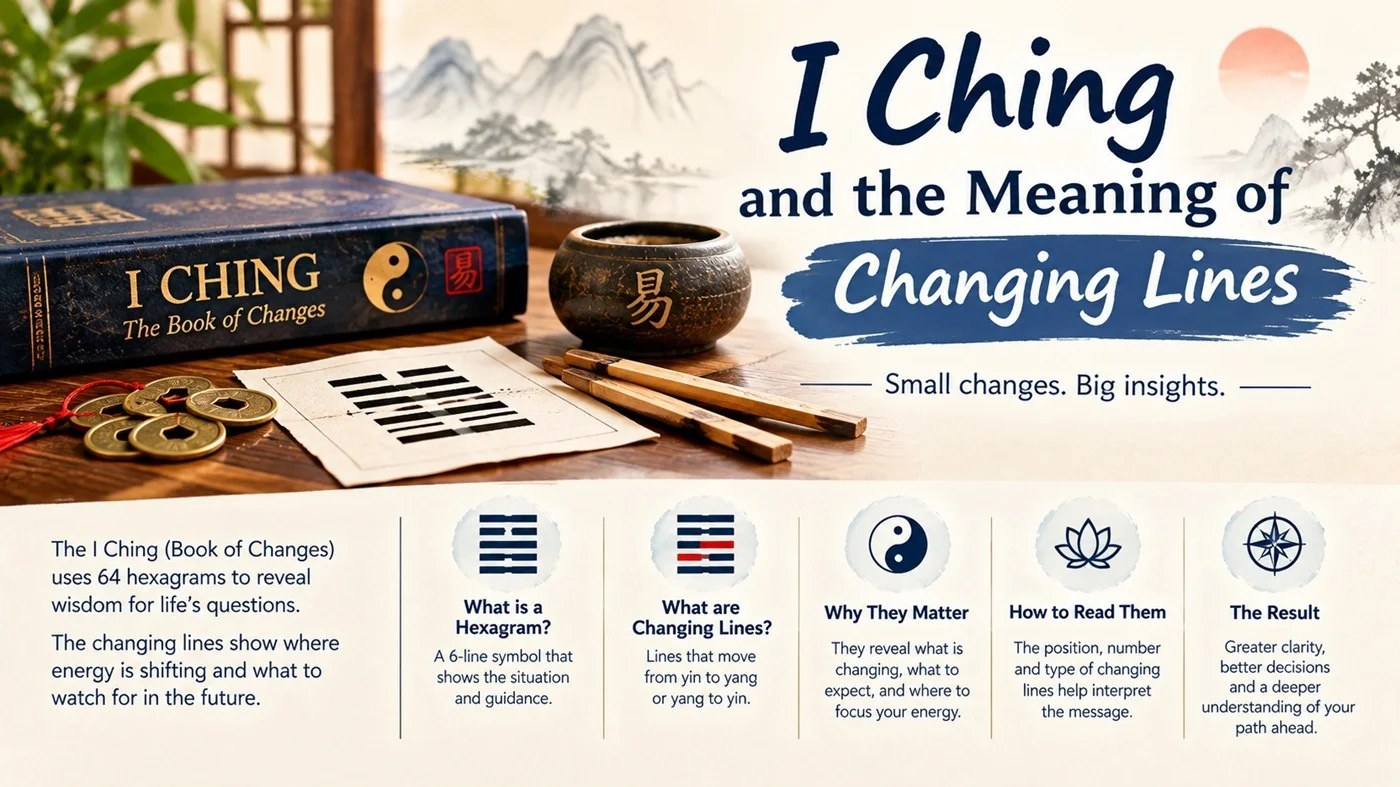
I Ching and the Meaning of Changing Lines
The I Ching, also known as the Book of Changes, is one of the oldest divination and philosophical systems still in use today. While many people first encounter it as a method for receiving guidance, its deeper focus is not simply on predicting a fixed future. Instead, the I Ching is concerned with change: how a situation is developing, where tension exists, and how a person may respond wisely to changing circumstances.
One of the most distinctive parts of an I Ching reading is the concept of changing lines. Understanding these lines helps explain why an I Ching reading can describe both the present condition and the direction in which that condition may be moving.
How an I Ching Reading Produces a Hexagram
A traditional I Ching reading produces a six-line figure called a hexagram. Each line is either yin or yang.
Yang is represented by an unbroken line, while yin is represented by a broken line. The six lines are built from the bottom upward, one line at a time.
One common traditional method uses three coins. Each coin is assigned a numerical value, and the three values are added together. This produces one of four possible line values:
6 — old yin
7 — young yang
8 — young yin
9 — old yang
The six results together form the primary hexagram, which represents the structure of the situation being examined.
For readers who want to see how this process works in a practical online setting, Chingley provides a traditional coin-based I Ching reading experience at:
The important point is that the hexagram is created first. Interpretation comes afterward. The question helps give context to the reading, but it does not need to determine which hexagram appears.
What Makes a Line “Changing”?
Not every line in a hexagram changes.
The values 7 and 8 are considered stable lines. Seven represents young yang, while eight represents young yin.
The values 6 and 9 are different. They are traditionally called old yin and old yang, and they are considered changing lines.
A 6 begins as yin and changes into yang.
A 9 begins as yang and changes into yin.
When one or more changing lines appear, the original hexagram can transform into a second hexagram. This second figure is often called the relating hexagram, transformed hexagram, or resulting hexagram.
This is one of the features that makes the I Ching especially focused on movement rather than static description.
The Primary and Relating Hexagrams
The primary hexagram describes the present pattern of the situation.
It can be understood as a snapshot of the forces, relationships, tensions, or conditions that are active at the time of the reading.
When changing lines are present, they show which parts of that pattern are unstable or in transition.
After those changing lines are transformed, a second hexagram appears.
This relating hexagram does not necessarily represent a guaranteed future event. It is often more useful to think of it as the direction of change, the emerging condition, or another perspective on how the situation may develop.
For example, a person may receive a primary hexagram that describes hesitation, difficulty, or uncertainty. A changing line may indicate that one particular part of the situation is beginning to shift. The relating hexagram may then show a different pattern that becomes relevant if the change continues.
Readers who want a more detailed explanation of this mechanism can find a practical guide to changing lines in the I Ching here:
https://chingley.com/changing-lines
Why Changing Lines Matter
Changing lines are important because they make an I Ching reading more specific.
A hexagram contains six different positions. A change in the first line is not interpreted in exactly the same way as a change in the sixth line.
The lower lines are often associated with earlier stages of a situation, while the upper lines may reflect later development or a condition that has reached greater maturity.
The exact interpretation depends on the hexagram, the line position, and the context of the question.
This means that two people can receive the same primary hexagram but still receive very different readings if different lines are changing.
In this sense, changing lines add another layer of detail to the reading. They help show not only what pattern is present, but where movement is occurring inside that pattern.
Change Rather Than Fixed Prediction
The word “change” is central to understanding the I Ching.
The system does not require us to imagine the future as a single fixed outcome. Situations develop because people make decisions, relationships shift, circumstances change, and new information appears.
A changing line reflects this dynamic quality.
For this reason, many people find the I Ching most useful when they approach it as a tool for reflection rather than as a machine that produces guaranteed predictions.
Instead of asking only:
“What will happen?”
It can be more useful to ask:
“What should I understand about this situation?”
“What is changing here?”
“What part of this situation requires my attention?”
“What would be a constructive way to respond?”
These questions leave room for both guidance and personal responsibility.
Asking Better Questions
The quality of an I Ching reading can also depend on the way the question is framed.
Questions that focus on the reader’s own choices are often easier to work with than questions that attempt to discover another person’s hidden thoughts.
For example, instead of asking:
“Does this person secretly love me?”
A more reflective question might be:
“What should I understand about my relationship with this person?”
Instead of asking:
“Will my business definitely succeed?”
A person might ask:
“What should I pay attention to as I develop this business?”
The I Ching can then be used to examine the structure of the situation rather than to make an absolute claim about an outcome that has not yet occurred.
Conclusion
Changing lines are one of the most important ideas in the I Ching because they express the principle that situations are rarely completely static.
The primary hexagram shows the present pattern. Changing lines identify the areas that are in transition. The relating hexagram shows how the pattern changes when those moving lines transform.
Together, these elements create a reading that is less about a fixed prediction like Vedic Astrology predictions and more about understanding movement, timing, and response.
That is also why the I Ching has remained meaningful to readers for so long. Its central question is not simply what the future will be, but how change is already taking place and how we choose to meet it.

Astrologer Navneet Khanna, is a former World Bank & SIDA consultant, he has held many prestigious projects in India and Africa before settling down in his native place, near Chandigarh and following his passion in Vedic Astrology. Navneet is very scientific and logical in his Predictions. He reasons his predictions because of which he has a worldwide following and people from many countries solve their problems with his help.
He is an expert in Marriage and Love Relationship. In Marriage Matching he does analysis of Guna Milan and also Grah Milan (Matching of the Planets) and will tell you effects and remedies of Nadi Dosha, Bhakoot Dosha & Gana Dosha if present.
He is an Expert Astrologer on Many Indian & Foreign Websites like myastrologysigns.com and a frequent writer for many national and international websites and magazines.
Navneet believes that Vedic Astrology is a vast subject, it is an ocean of knowledge and wisdom. It is simply up to the individual to jump into the ocean and extract the pearls. With his vast experience on occult subjects he has been associated with leading astrologers in India to promote astrology.
Navneet Khanna believes that the energy and inspiration behind him is the Blessings of the Almighty.
You may call / whatsapp him on his number +91-9417884861 .


